Feudal lord = judge
Jurisdiction without land, heredity and personal interest.Emil Venn · Author & essayist
WHO OWNS TOMORROW?
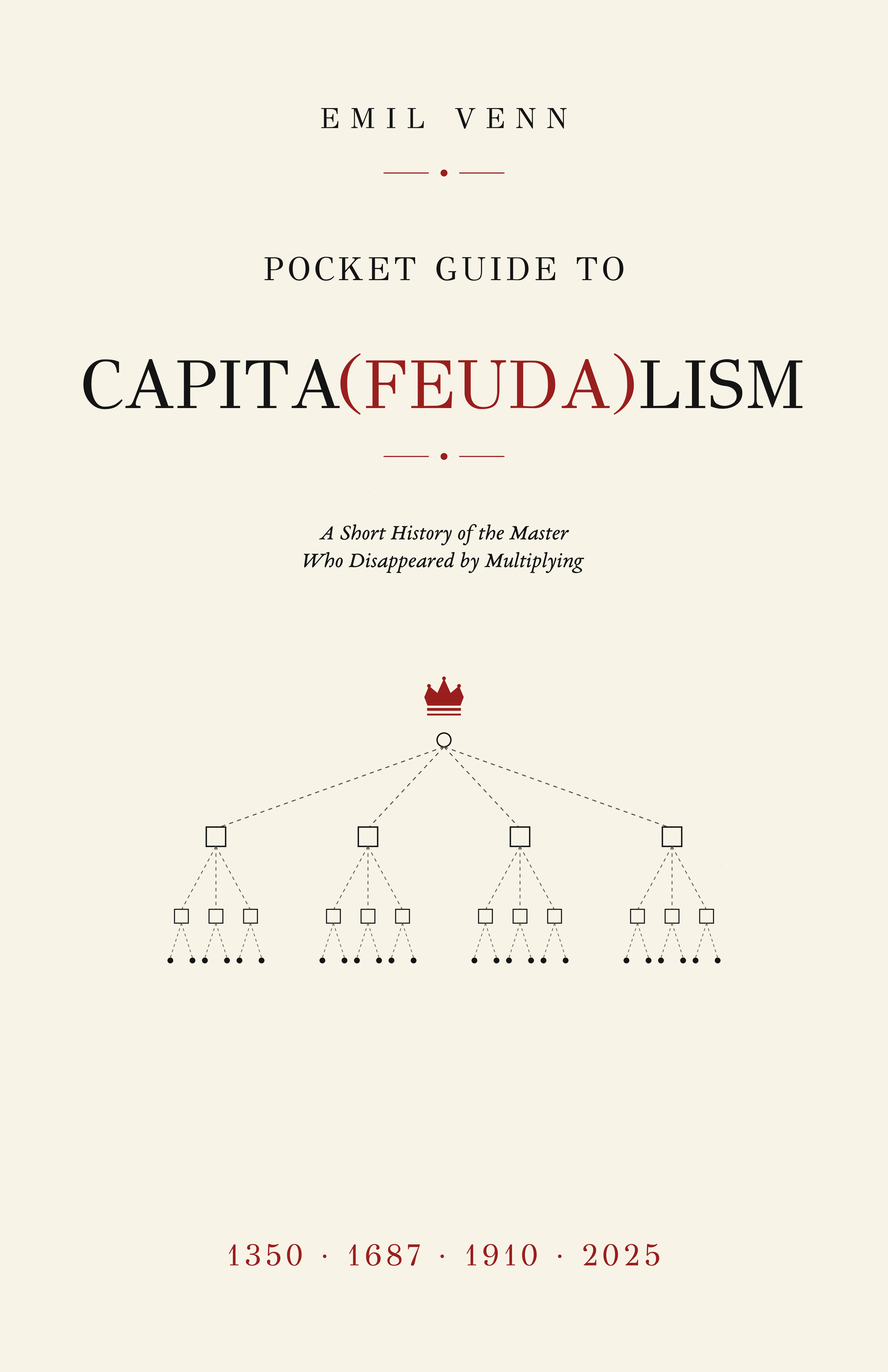
Pocket Guide to Capita(feuda)lism
A Short History of the Master Who Disappeared by Multiplying
1350
1687
1910
2025
The idea
The old master did not simply disappear. His functions were divided.
The book uses four deliberately provocative equations as analytical tools. They are not historical definitions. They ask where authority, risk, work and dependency moved when personal lordship was replaced by institutions, offices, contracts, platforms and procedures.
Emperor = minister
Sovereign power transformed into temporary public office.Servant = employee
Working capacity placed temporarily inside an organization the worker does not own.Serf = entrepreneur
Production, immediate risk and superior claims examined beneath the title of ownership.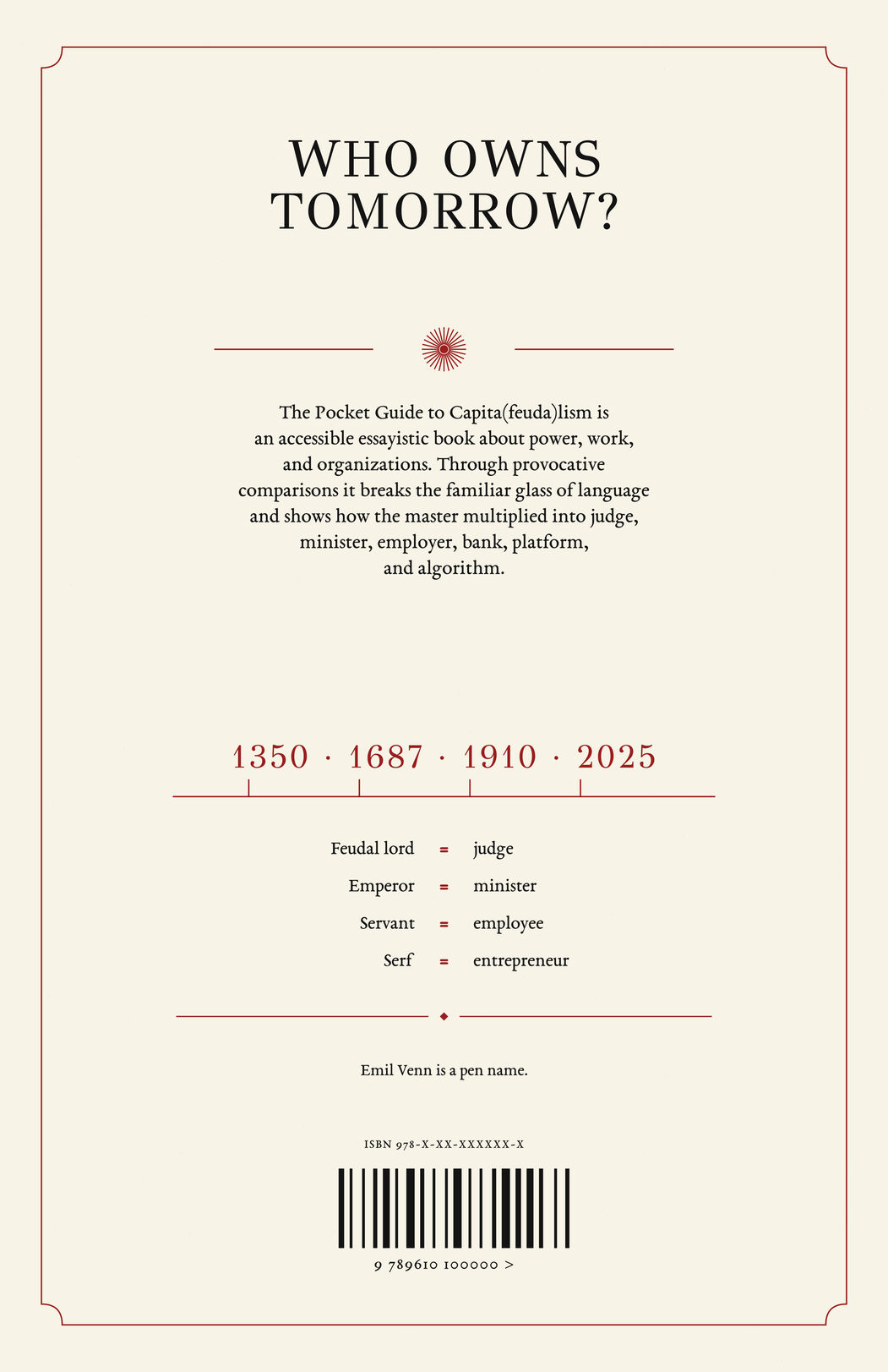
The book
Pocket Guide to Capita(feuda)lism
A Short History of the Master Who Disappeared by Multiplying
A popular essayistic book about power, work, and organizations.
The book moves through 1350, 1687, 1910 and 2025 to examine how power changes form when older functions are separated, standardized and distributed across modern institutions.
First print run: 100 copies. This first edition is intentionally identified as an unedited version.
The supplied cover artwork contains placeholder ISBN/barcode data. Replace those production identifiers before commercial printing.
Book preview
Read the first ten pages
The preview below reproduces the first ten pages of the supplied 2026 English DOCX manuscript as rendered pages, preserving the original page design, typography, spacing and pagination.
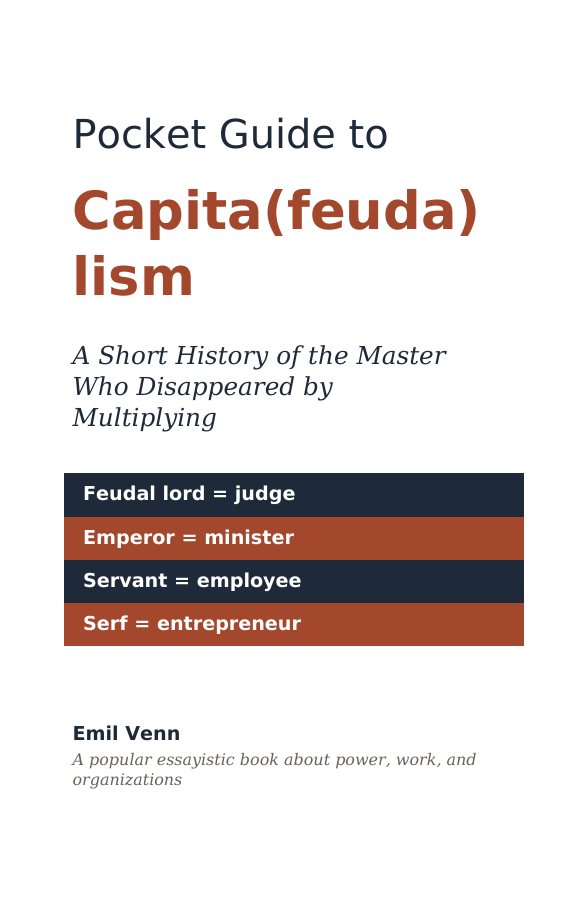
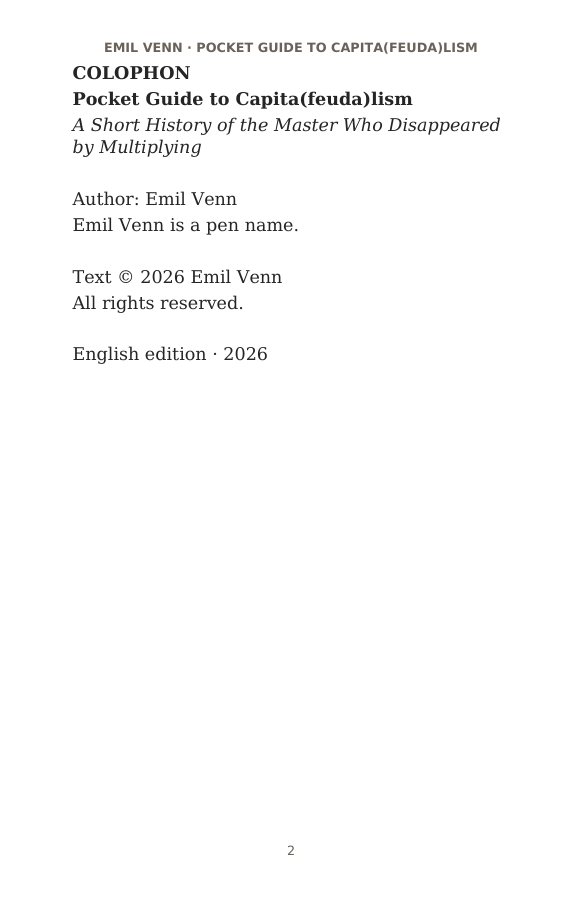
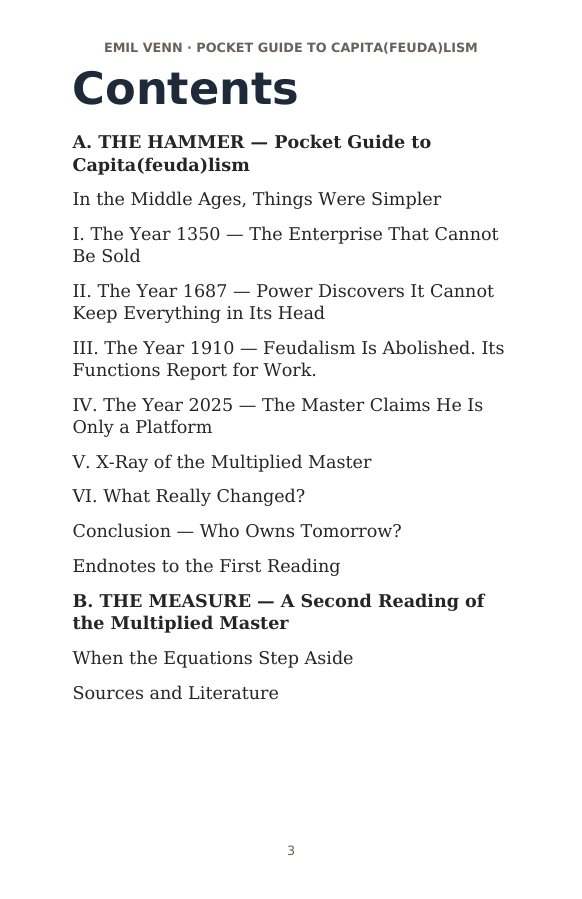
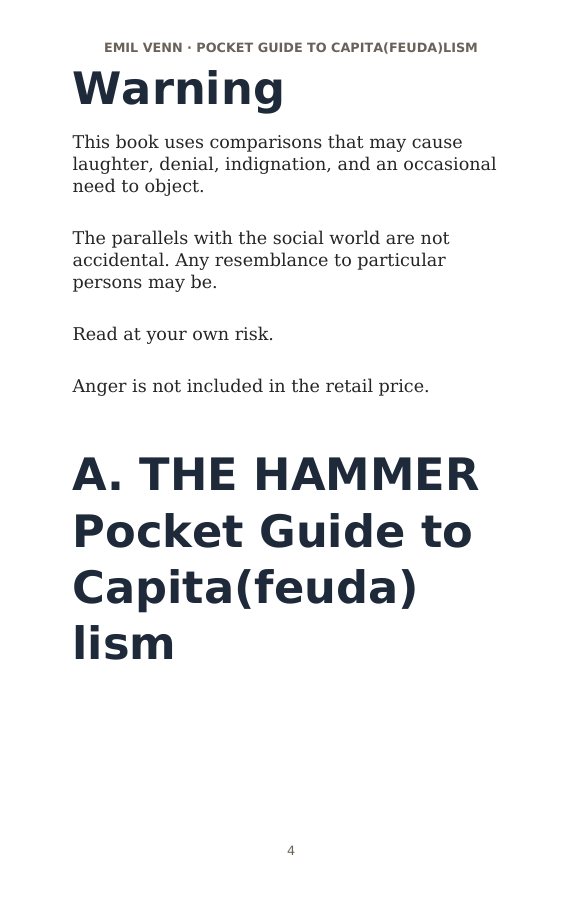
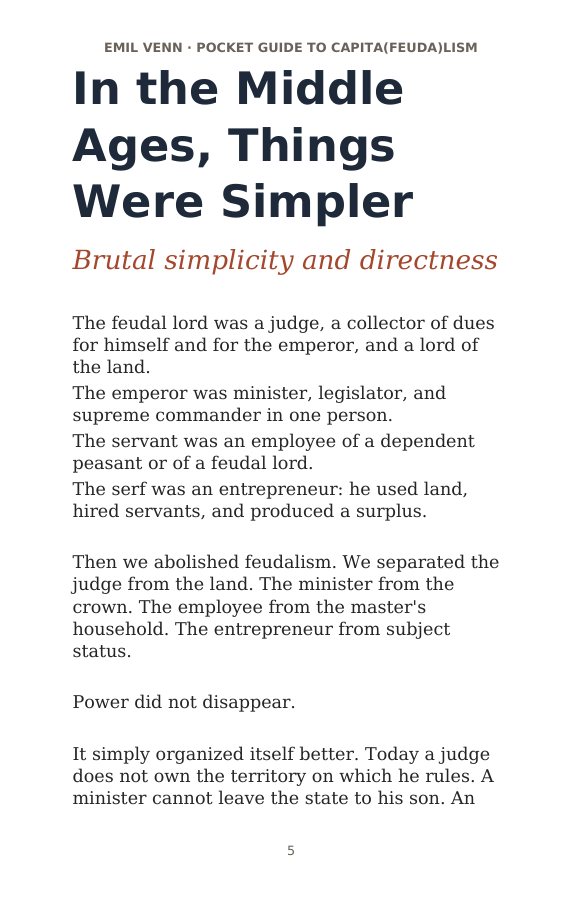
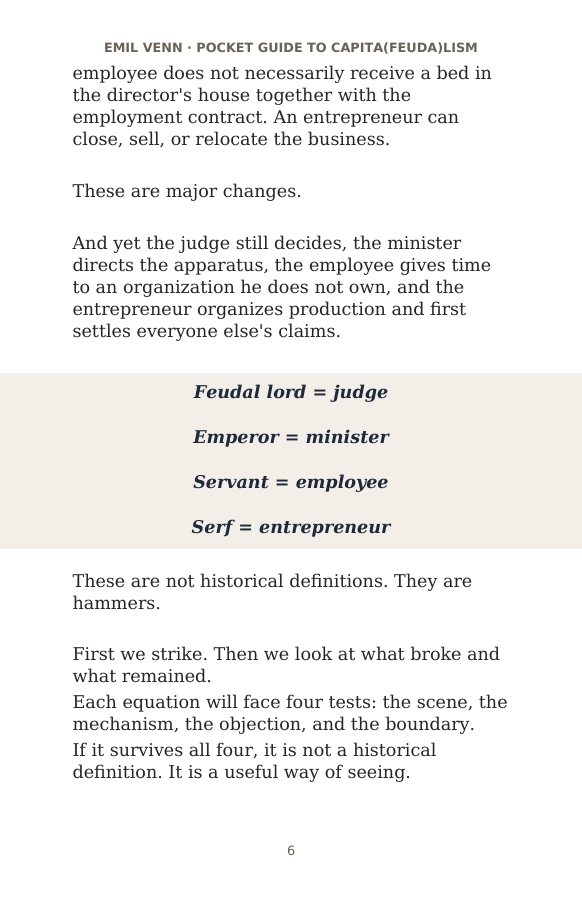

Rendered directly from the supplied English DOCX manuscript. A plain-text version of the same ten pages is available for accessibility, search and language-model indexing. Accessible text of the 10-page preview.
Where to buy
Retail links will be added when confirmed. EmilVenn.com does not process orders, payments or shipping in this version.
EV
EMIL VENN
About Emil Venn
Emil Venn is a pen name. The work published under this name examines power, work, organizations and the structures that determine who can decide, who must comply and who bears risk.
The method combines deliberately provocative comparisons with explicit objections and boundaries: first break the familiar frame, then test what remains.
Questions
Is capita-feudalism presented as literal feudalism?
No. The book and essay use the comparison as an analytical instrument and explicitly examine where the analogy fails.
Can I buy directly on EmilVenn.com?
Not in this version. The site will direct readers to confirmed external retailers.
Is Emil Venn a pen name?
Yes. The 2026 edition identifies Emil Venn as a pen name.